

Every organization has one.
It’s the project that always seems to be in progress.
Maybe it’s a website redesign that’s been under discussion for far longer than anyone expected. Maybe it’s a strategic initiative that keeps getting pushed into the next planning cycle. Maybe it’s a report, campaign, or communication effort that feels perpetually one revision away from completion.
Nobody has intentionally abandoned it.
In fact, most people still agree it’s important.
Yet somehow it never quite reaches the finish line.
The project continues to appear in status meetings and planning documents. It resurfaces during quarterly reviews. New conversations begin before old ones have been resolved. Time and attention continue to be invested, but completion always seems just out of reach.
Eventually, the project becomes part of the organizational landscape.
Not finished. Not failed. Just lingering.
These are the projects that become the never-ending story.
And while they may seem harmless, they create a unique kind of drag—consuming attention, delaying decisions, and quietly competing for resources long after they should have been resolved.
When Momentum Turns Into Dread
Most projects begin with optimism. There’s energy around the idea. Stakeholders are engaged. Progress is visible. The destination feels achievable, even if the path isn’t entirely clear. For a while, things move forward. Meetings are productive. Decisions get made. Milestones are crossed off the list.
Then something changes.
A deadline slips. New priorities emerge. Additional stakeholders enter the conversation. A decision gets deferred because “we should think about it a little longer.” The project keeps moving, but progress starts to slow.
Weeks become months. Months become quarters. The project is still active, but the energy that once surrounded it has quietly disappeared.
The most difficult phase of a project is often not the beginning or the end. It’s the long middle period when momentum fades and completion starts to feel uncertain.
The conversations become familiar. The feedback becomes repetitive. Team members begin revisiting issues that felt settled months ago.
That’s when something subtle begins to happen.
People stop looking forward to the project. They avoid opening the document. Emails sit unanswered. Meetings get pushed to next week and then the week after that. What was once an interesting challenge gradually becomes a source of low-grade dread.
The project is no longer new enough to be exciting, but not complete enough to be forgotten.
The longer a project lingers, the more emotional energy it consumes—even when no one is actively working on it.

Why Projects Get Stuck
When organizations diagnose a stalled project, they often assume the problem is execution. Maybe there isn’t enough time. Maybe resources are stretched too thin. Maybe the workload simply turned out to be larger than expected. Occasionally that’s true. More often, the project is waiting for something else entirely.
A decision.
Most never-ending projects don’t suffer from a lack of effort. They suffer from a lack of decisions. At some point, progress becomes dependent on a choice that nobody wants to make. Stakeholders have competing priorities. The team is trying to satisfy multiple objectives at once. Everyone wants the outcome to be successful, but nobody wants to be responsible for choosing a direction.
Instead of deciding, the project stays active.
Additional feedback is gathered. More revisions are completed. New requirements appear. Discussions continue. The work continues, but the project doesn’t move forward.
A website redesign becomes a content strategy exercise. A report expands into a larger initiative. A marketing campaign becomes a discussion about future organizational goals.
The finish line keeps moving. And every time it moves, the likelihood of completion gets a little smaller.
The Hidden Cost of "Almost Done"
Organizations often underestimate the cost of unfinished work because they focus primarily on budgets and timelines.
The more significant cost is attention.
Every unfinished project occupies space. It appears in meetings. It resurfaces in planning discussions. It consumes mental bandwidth every time someone remembers it still exists.
Consider a website redesign that began with a straightforward objective: improve navigation, modernize the design, and clarify the messaging. Eighteen months later, the project is still underway. New stakeholders have joined the conversation. Additional features have been suggested. Content governance questions have emerged. Future functionality is now part of the discussion. Everyone still agrees the website needs to be completed. Nobody can explain why it isn’t.
This is where many projects become trapped.
The original objective gets buried beneath layers of additional expectations. Progress becomes difficult to measure because nobody is quite sure what “done” looks like anymore. Meanwhile, the project continues consuming attention without delivering value.
Because projects create value when they are completed—not when they are perpetually being refined.
Done is often more valuable than better.
How to Avoid Creating One
The best way to solve a never-ending project is to prevent it from becoming one in the first place. That starts by defining completion before the work begins.
Most teams spend time discussing objectives, budgets, timelines, and deliverables. Far fewer spend time discussing what will actually constitute success and what conditions will allow the project to be considered complete.
Without a shared definition of completion, projects become vulnerable to endless refinement. Every new idea feels reasonable. Every additional feature feels worthwhile. Every suggestion seems worth considering. Individually, none of these decisions appear harmful. Collectively, they create drift.
Successful teams establish boundaries early. They identify who has authority to make decisions, what outcomes matter most, and what tradeoffs they are willing to accept.
Most importantly, they agree on what “done” looks like before they start.
Rescuing One That's Stuck
If a project has already entered never-ending territory, more effort is rarely the answer. The first step is identifying what is actually preventing completion.
Not improvement. Not optimization. Completion.
The answer is often surprisingly small. One unresolved decision. One stakeholder conversation that has been avoided. One assumption that nobody wants to challenge.
Once identified, create a new finish line. Not the ideal finish line. A realistic one.
Reduce the scope if necessary. Eliminate secondary objectives. Focus on the smallest version of success that still creates meaningful value.
The goal is not to lower standards. The goal is to restore momentum. Because momentum rarely returns on its own. It has to be rebuilt.
Making it Done
Every unfinished project occupies space.
Not just in budgets or project plans.
It occupies space in conversations. In status meetings. In people’s minds.
Team members remember the project every time it appears on an agenda. Leaders revisit it whenever priorities are discussed. Stakeholders carry around a lingering sense that something important remains unresolved.
The longer a project stays unfinished, the heavier it becomes. That’s why the goal isn’t always to make a project better. Sometimes the goal is simply to make it done.
Finished projects can be improved.
Unfinished projects simply linger.
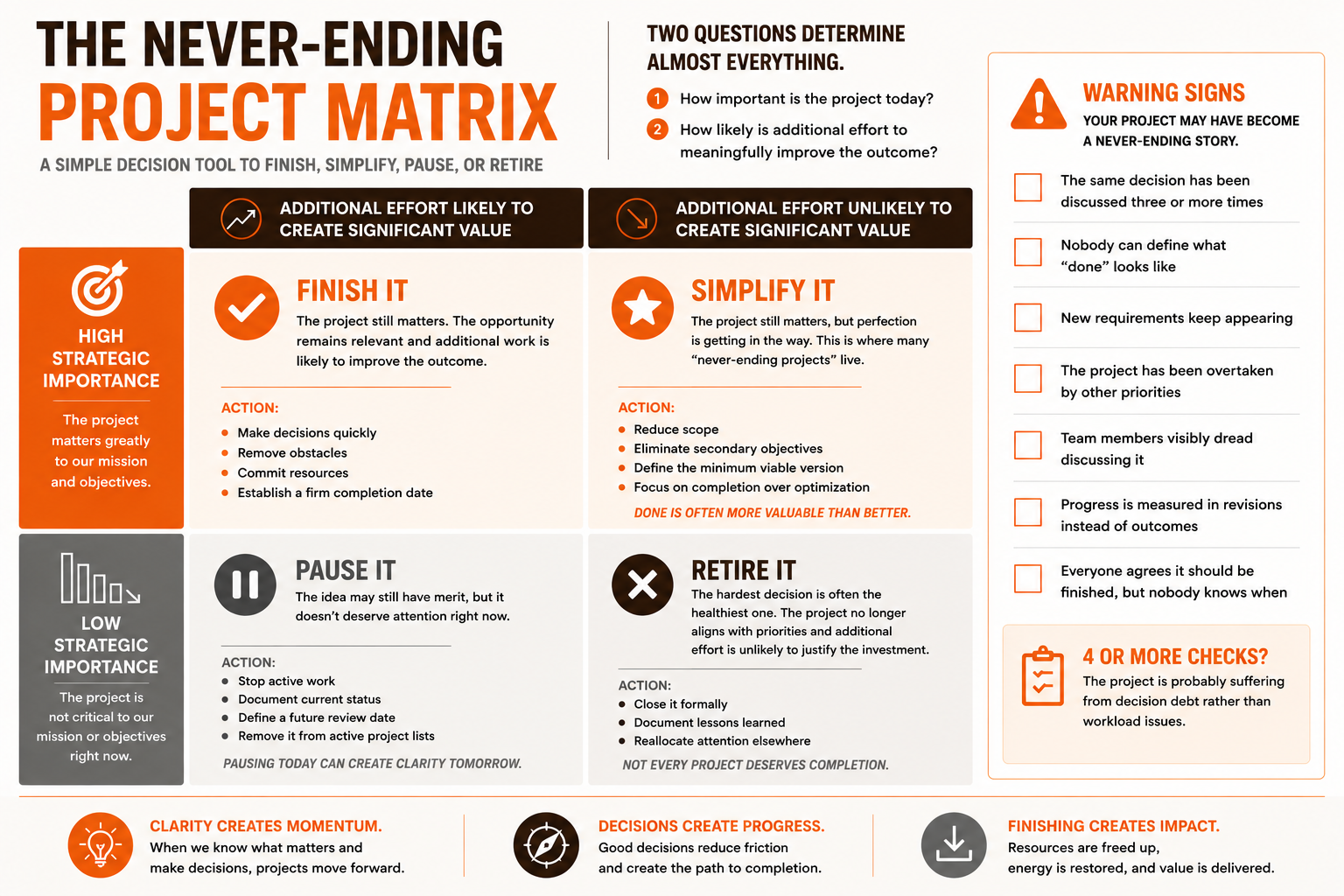
The Never-Ending Project Matrix
When a project has been active for months—or even years—it can be difficult to evaluate objectively. This matrix is designed to help identify whether additional effort is likely to create meaningful value and whether the project remains strategically important. By answering two simple questions, you can determine the most productive path forward and avoid spending more time, energy, and attention on work that no longer deserves it.