


It usually starts with one perfectly reasonable request. “Can we add this to the newsletter?” Of course. It’s relevant. There’s room. In it goes.
Then comes an event announcement. A deadline. A new resource. A message from leadership. A staff accomplishment. Three upcoming workshops. Something another department would really like people to know about. And, while we’re at it, could we remind everyone about that thing from last month? Before long, the newsletter has eaten everything.
There’s a reason newsletters attract so much content. Email remains the anchor of internal communications. According to Workshop’s 2026 Internal Comms Trends Report, 95% of internal communications teams use email, and 81% say it’s their most effective channel.
When a communications channel reliably reaches people, everyone wants to use it. That’s a good problem to have. Until the newsletter becomes the default destination for every announcement, event, update, reminder, and request.
The problem isn’t necessarily that there’s too much to communicate. Most organizations have plenty worth sharing. The problem is that collecting has replaced curating. A good newsletter editor does more than decide what gets in. They decide when something belongs, how prominently it should appear, and what can wait.
Because your readers have limited attention. Deciding where to direct it is part of the job.
Think like a curator
 A museum curator has access to far more material than can possibly appear in a single exhibition. The job isn’t to put everything on the walls. It’s to choose what belongs, create relationships between things, establish hierarchy, and give the most important pieces enough room to make an impression.
Newsletter editors have a surprisingly similar job. Every organization generates more information than its audience can reasonably absorb. That makes selection valuable.
Instead of asking only:
“Should we include this?”
Try asking:
“When does our audience need this, and how much attention does it deserve?”
Those questions shift the conversation from inclusion to editorial judgment. And they make it possible for something to matter without automatically becoming a feature story.
Timing is part of the message
Communications calendars tend to be organized around when information becomes available.
- The event was announced, so put it in the newsletter.
- The report was published, so include it.
- The registration page is live, so promote it.
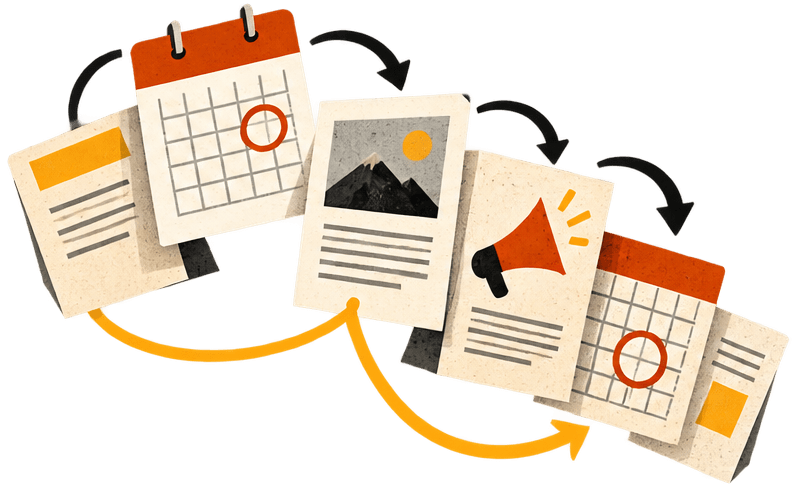 But the better question is when the reader needs to know. An event six weeks away might deserve a brief mention today and a prominent feature closer to the registration deadline. A resource with no particular urgency might be more useful in a quieter issue where people actually have time to notice it. A deadline coming up tomorrow may deserve top billing even if it isn’t the most exciting thing happening in the organization.
Sometimes the right editorial decision is: This matters. Just not yet.
Waiting isn’t ignoring the content. It’s choosing the moment when it has the best chance of being noticed.
Everything doesn’t need the same amount of attention
Once something makes the newsletter, another problem often appears: everything starts looking important.
Headline. Image. Paragraph. Button. Headline. Image. Paragraph. Button. The design may be perfectly consistent. The experience is exhausting. Visual hierarchy is more than a design technique. It’s an editorial decision.
- A major announcement might deserve a photograph, a strong headline, several sentences of context, and a prominent call to action.
- An upcoming event might need a date, one sentence, and a registration link.
- A useful resource might need nothing more than a descriptive link.
- And some information might be better saved for another issue.
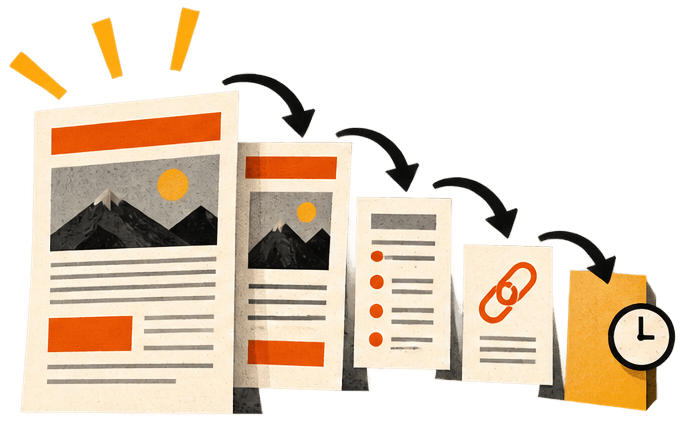 Think of the options as a continuum:
Feature → Supporting story → Brief → Link → Later
The goal is to match the amount of space and emphasis to the value of the information at that particular moment. If everything receives the same emphasis, the reader has to figure out what’s important. Curation does that work for them.
Your newsletter needs a point of view
This doesn’t mean every newsletter needs to become an opinion publication. It means someone needs to make choices. What is most useful to readers this week or month? What has changed? What deserves attention now? What connects naturally? What can be communicated in a sentence? What deserves more explanation?
And underneath all of those questions is a bigger one: What is this newsletter here to do?
Some newsletters primarily keep employees informed. Others build community, promote opportunities, share expertise, drive people toward resources, recognize accomplishments, or connect members of an organization who may rarely interact otherwise. Most do several of those things.
But when a newsletter tries to accomplish every possible communications objective in every issue, its purpose begins to disappear. A clearly understood editorial purpose makes individual decisions much easier. “This is important” becomes only the beginning of the conversation. Important to whom? Important when? And important enough for what?
Repetition can be useful. Repetition without a plan isn’t.
Sometimes information needs to appear more than once. People miss things. Deadlines get closer. Priorities change. An event that was worth a small mention last month may deserve a much bigger push this month. That’s different from simply running the same announcement issue after issue.
Good curation can build emphasis over time. A conference might begin as a save-the-date, become a feature when registration opens, move into a prominent reminder as the deadline approaches, and disappear once the moment has passed.
The information hasn’t simply been repeated. Its role has changed as the reader’s need has changed. That kind of rhythm makes a newsletter feel current rather than cumulative.
Make room for something to stand out
There’s another benefit to curation: restraint creates emphasis.
A strong story surrounded by twelve other strong stories has to fight for attention. Give that same story more breathing room, and suddenly it feels important.
Adding one more item to a newsletter isn’t free, even when there’s room for it. Every additional headline, photograph, button, and announcement competes with everything already there.
The question isn’t simply whether another item fits. It’s whether adding it makes the entire newsletter more useful. Sometimes the best editorial decision is to give what’s already there more room to work.
The Newsletter Curator Test
Before the next issue goes out, try looking at every potential item through two lenses:
Timing
When does the reader need this?
Now · Soon · Later
Emphasis
How much attention does it deserve?
Feature · Brief · Link
Put those two decisions together and you have a much more useful editorial question than simply include or exclude. You have a way to decide what role each piece of information should play.
A good newsletter earns attention
There will always be pressure to include one more thing. In some ways, that’s a compliment. People want to be in the newsletter because they believe people pay attention to it.
The best way to protect that value is to keep giving readers a reason to pay attention. That means treating their time as something worth respecting. It means making choices on their behalf. It means helping them see what matters without requiring them to sort through everything the organization could possibly tell them.
Because the best newsletters aren’t comprehensive archives of everything that happened.
They’re curated experiences of what matters now.