

The challenge has shifted.
Not long ago, a blank page was the biggest obstacle to creating content. Today, it’s often the opposite. AI can produce a blog post, email, social media campaign, or annual report faster than most of us can finish our first cup of coffee.
Instead of asking, "How do I write this?" organizations are increasingly asking, "Is this good enough to publish?"
That’s a much more important question.
AI has become remarkably good at producing writing that is grammatically correct, logically organized, and professionally formatted. But it also has a tendency to smooth away the very qualities that make an organization memorable. It favors language that is broadly acceptable over language that is distinctly yours.
If every organization uses the same tools in the same way, the greatest risk isn’t that AI will make your writing worse. It’s that it will make everyone’s writing sound the same.
Voice Is More Than Style
Many organizations think of brand voice as a writing style guide. Formal or conversational. Technical or approachable. Serious or playful. Those choices matter, but voice goes much deeper.
Your voice reflects your priorities. It reveals how you solve problems, what you value, and how you relate to the people you serve. It’s the accumulation of countless decisions about tone, vocabulary, examples, stories, and perspective.
Those aren’t things AI invents—they’re things AI imitates It’s an important distinction.

The more clearly your organization understands its own voice, the more effectively AI can support it. Without that foundation, AI tends to default to a polished but generic style that could belong to almost anyone.
AI Should Draft. Humans Should Decide.
One of the biggest misconceptions about AI is that its value comes from replacing writers. In practice, its greatest strength is accelerating the parts of writing that consume time but not necessarily insight.
- Brainstorming.
- Outlining.
- Summarizing research.
- Generating alternatives.
- Rephrasing awkward sentences.
Those are excellent uses of AI.
Deciding what deserves to be said, how it should be framed, and whether it reflects your organization’s values—that’s still human work. The organizations getting the most value from AI haven’t eliminated the editor. They’ve elevated the editor’s role.
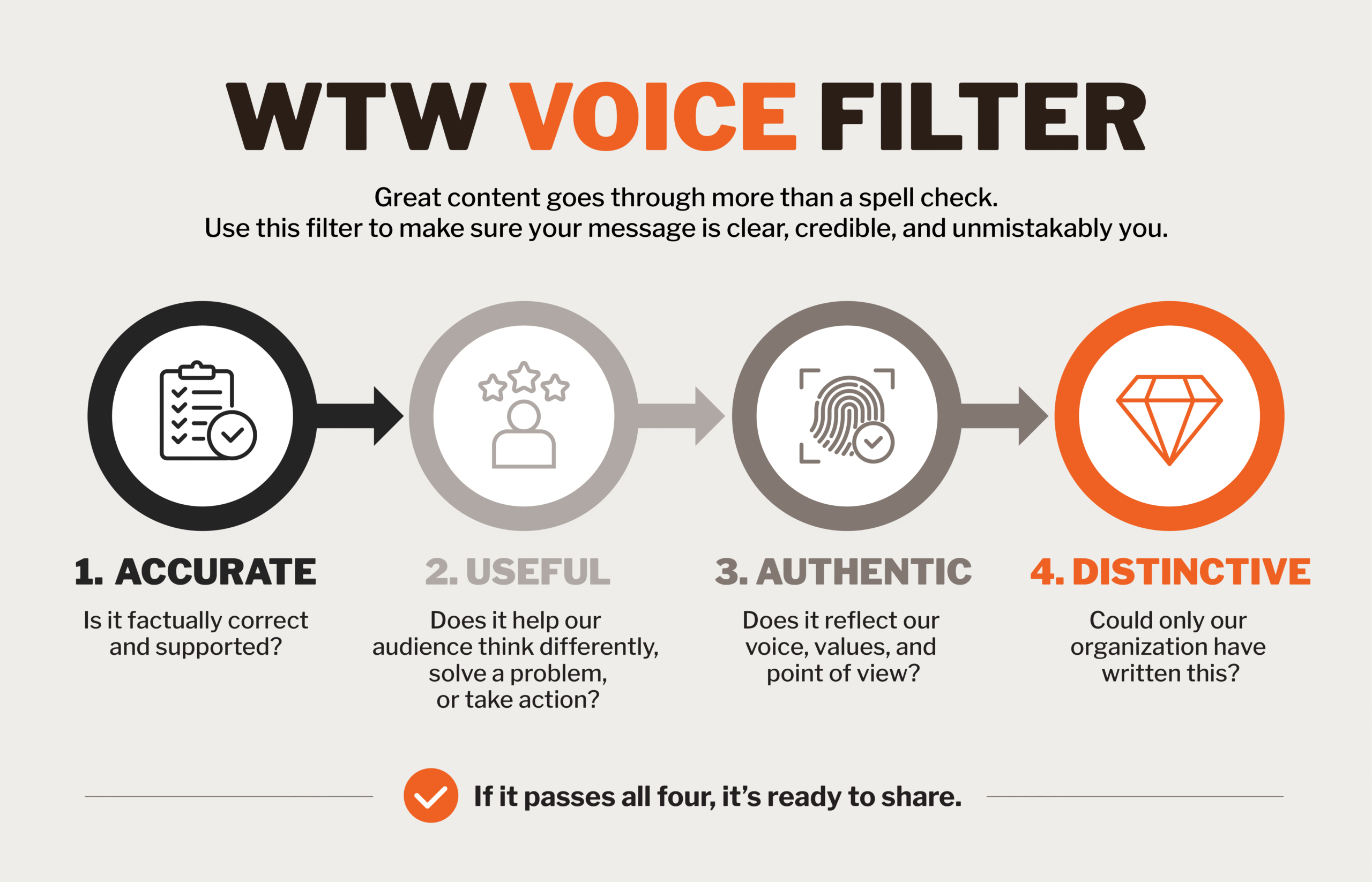
The Voice Check
Before publishing AI-assisted content, ask five simple questions:
1. Does this sound like us?
Could someone familiar with your organization recognize your voice, or could this have been written by anyone?
2. Does it say something worth saying?
AI can generate information. Your audience is looking for insight.
3. Does it reflect our expertise?
Generic advice builds very little credibility. Specific examples, experiences, and perspective build trust.
4. Is it genuinely useful?
Every paragraph should help your audience think differently, solve a problem, or make a better decision.
5. Would we proudly put our name on it?
If you hesitate, keep editing.
Your Voice Is Still Your Competitive Advantage
As AI becomes part of everyday communication, technical proficiency will become less of a differentiator. Nearly everyone will have access to similar tools capable of producing similar results.
What will continue to distinguish organizations isn’t their ability to generate more content. It’s their ability to generate content that feels unmistakably human.
People don’t build relationships with algorithms. They build relationships with organizations that communicate with clarity, authenticity, and purpose.
Sure, AI can help you write faster. But your voice is what gives people a reason to keep reading.